

Simon / Shared Universe / The Darkest Age / Photon Road 9
Packed with good stuff this week. A new short (let's get weird!), thoughts on writing in shared universes, a bit about the new RPG, and finally more PHOTON ROAD!

A Simon Story
The vast black demands your attention.
Nebula swirl in purple and gold, while nascent stars ignite and burst into radiant life. Tatters of reality, this one and that, swirl around one another, sharing energies and twisting the nature of the universe into unrecognizable possibilities.
There floats a city in the void, a craggy piece of rock, plastic, and alloy. It has a name, has had many names, and will likely be given another name in the future. It is a place that suffers from all the contradictions of the benefits of civilized behavior. Things that sentient species only endure within a society – theft and slavery mostly. Corrupt cops mingle with pirates and whores who dance with slavers who have truck with fiends and even more vile corporations.
The place is a convoluted conglomerate of city center, species ghettos, and strangely growing suburbs. It expands in all directions, new regions bursting forth like a dividing cell. Awkward polyhedra cluster around the long-lost original shape like barnacles. It is like so many other outposts of life and civilization in the emptiness of space, yet so different. Here, at this place, great energies are generated, manipulated, forgotten about, and left to combine in unconventional ways. The result is a nexus of realities, a maelstrom of bending universal rules and, of course, confused sentient beings.
My name is Simon and I live here because I can’t live anywhere else.
If I were to leave my domicile and someone recognized me, it would be dangerous for me and potentially disastrous for many others.
The Next Part
“This is small stakes shit,” I said to Andrew, my therapist and confessor. His physical presence is located somewhere in the spinward districts, below the Observatory, but above the Shipyards. I’ve never actually been there, but it sounds nice. The holo displays make it seem a little cluttered, but Andrew is busy and I’m sure doesn’t have an android to clean or even make meals. I’m not sure if Andrew eats.
Andrew is tall. His hair is salt and pepper, his mouth wide, and his eyes glitter with implants. Storms of nanites race across his sclera and pupils, responding to his information requests, re-evaluating light waves across the spectrum. Andrew peers deep into anything he takes the time to consider. I’ve always liked to think that he’s just looking to see if there’s anything the rest of us missed with our own stock and package eyes. His nose is sharp. Back in the days of old Earth, I think they’d have said he had a patrician look. His skin is pale, but subdermal implants run just below the surface, leaving gently glowing tracers. Andrew is lean, and though looks are always deceiving, he appears to be reasonably fit. He’s always armed, which is not uncommon for Here, but I find that fact to be incongruent with the persona he cultivates. Andrew is mostly human, I think; he comes from the old colonies, though, so he’s probably had most of his original bits replaced and rebuilt. Andrew dresses in swirling light, a somewhat dated fashion statement, but striking nonetheless. I met Andrew through a mutual acquaintance, Herrox, the Horse-Philosopher.
I sat patiently. Andrew conjured up a scathing smile and said, “No. What you are internalizing is small stakes shit. What we are talking about here is the destruction of a whole world.”
He always did this to me. It was hands-down manipulation, but he was also attempting to appeal to my better nature – I certainly had no desire to see an entire planet die. Then again, why was this always my problem? When scientists on Sannerja created their own personal black hole, I moved it away from the population centers of the system until I could find somewhere to put it. That little miracle took everything I had, as well as a team of technical specialists who mostly died. When the World-Ship of Osteon kidnapped (it’s complicated but they do it every generation) their new Grand Navigator from the stone-age peoples of Axion-B, and lost the poor girl in the ships innards, I was the one who entered the monstrosity’s bowels, waged a small war against its own internal defenses, found her, and finally returned her to the bridge days later. I convinced Thoth to use World-Wiki. I once even supplied the enigmatic spark necessary to create life on a primordial world known only as Five. I really don’t see how I should have to leave my very comfortable home Here and put my precious self in harm’s way again. I’m not indestructible, just very, very hard to kill. So, you know, let someone else do this.
I shook my head at him, “No, no. I’ve done my time. I’m broken. I’m tired. I’ve got brunch with Herrox tomorrow.” He smiled and took a sip of what I assume was some gangrenous-colored tea, thick with herbs and tree snot. I sipped my drink, using the pause to gather my thoughts.
“You are able to help. So why don’t you? That is the cosmically accepted definition of a Sentient Species, according to the First Articles.” His voice was calm, even, and infuriating.
“Haven’t I already?” I wanted a cigarette. I hadn’t craved a smoke for 200 years or more.
“The galaxy is always changing. You need to adapt. Your role in this existence is multifaceted and changing.”
Multifaceted. Ass-hole. I imagine you’re asking how I got this way, why it’s me and not you, and perhaps even what this way actually is. That’s reasonable. It’s a long telling, so I’ll give you the short version. I once loved an alien woman, a S’cova. The S’cova are known to be able to see deeper into the electromagnetic spectrum than most critters, and their art reflects that. Back then, I was a simple art thief, working on Estra Prime for a hot minute. She and I, well, we helped ourselves to some of the finest S’covan art pieces around. In this galaxy, there’s always some rich ass-hole who wants to show off his wealth and pocket something rare and unique. Art collection is one hundred percent ego.
Anyway, she double-crossed me. I ended up in penal-stasis for I don’t know, maybe thirty years? I escaped, and Bob’s-your-uncle, I discovered one of those rare and magical places in the universe that poets wax on about and entertainment directors struggle to bring to life in the holos. It was a lush green world, growing fresh and new, recovering from a predictable but unavoidable extinction event. There were plants, but no complex animal lifeforms. Eden without mosquitoes, you see? It was perfect. No one knew the place; my guards, keepers, and handlers were long dead, and I was lucky to survive the re-entry.
Exploring the world, I came across a cave and decided to use it for shelter while I pondered a way to escape this new prison, though Eden-like it was. Inside the cavern, I found a pre-made shelter, though it was clearly very old. There was evidence of long-term habitation, eating utensils, books, data slates, and clothing. Deep into the cavern, I found a skeleton. It was wearing a pressure suit and a utility belt. None of the bones were broken, so determining the cause of death was beyond my abilities at that time. The skeleton was wearing a medallion, which looked to be made of gold with a gem in the center. I took that, the utility belt, and settled in, rearranging my new camp. It took me a day to fully explore the caverns. They were mostly empty, but as luck would have it, there was a laser-cut path that led to a hidden landing platform. Perched silently and patiently on the platform was a ship.
My past as a thief offered me the opportunity to pick up a variety of skills that most folks would consider unsavory, but those same skills allowed me to access the ship. It was overgrown with vines, probably almost impossible to detect from orbit, unless one was surveying for alloys. Anyway, I found that the ship’s gamma generator was working flawlessly. I had the means to escape. But I didn’t – not at first. I spent weeks poring through the books and data slates, idly at first while I pondered what my next move was going to be. But after a time, I grew interested, then fascinated, and finally obsessed with the dead man’s work. He was seeking something he referred to as “the ascension effect.”
Then, so was I.
My dead friend had apparently devoted his life to the search and acquisition of materials, data, and artifacts that can be used to track down and master the “ascension effect.” What is the ascension effect? I’m not sure, really, even now. Space magic, I guess. I took all the data and left that unknown world. I followed his clues, maps, and instructions for the next two years and odd months until I finally found it. Blah, blah, blah, ancient temple, unusual energies, and the requisite strangeness of the universe combined to make me into something a little more than that average art thief. This was some time in the past. Many adventures later, I find myself an unwitting prisoner of time dilation and the other distortions of the commonly accepted patterns of reality that occur when dealing with lots of energy. The details are for another story.
Andrew’s holo sipped at his tea; a flicker of distortion ran through his image.
“The situation is such that if you don’t get involved now, you’ll have to later.”
“Existence won’t end if one planet slips into an artificial singularity.” I shook my head.
“No, not yet.” He said.
“Not yet?” I sighed, not really wanting to hear the details, but knowing they were forthcoming anyway.
“This individual world has been flagged as being extremely culturally important in the future.”
“The future?”
“Don’t believe me, go see the Whale.”
So I did.
The Whale Part
The Whale lived on the other side of Here, and down a few sections, in a ward called Ovancrick. It was named after the ancient research fellowship, the Ovancrick Institute, because that was the first and largest component to be adhered to the conglomerate of Here. Now it’s a sprawling, half-submerged terrarium lined with twisting vines from a hundred worlds, fauna from as many more. Those who live there tend to work for the Whale, or are at least affiliated with the Whale’s businesses in some way. There are the occasional amphibious folk who like the scenery, or insectoids. I even heard a rumor that a sentient plant, which researches cross-spectrum chlorophyll, had taken up residence.
It took me an hour to get there. Inner-station transit offered many options. I sometimes took aerodyne taxis, but this particular time I wanted to wade through the population of Here, to see the masses move, ebb and flow. The chaos of travelers, new arrivals, starships coming and going, inspections, and crime was both disgusting and overwhelming. The tides of sentient life swarmed over everything, cutting and scraping away at the universe’s bones. Other times, the press of sentience was invigorating and refreshing – the mere presence of intelligent life this far out into the universe was a grandiose testament to the determination of the originally terrestrial species.
The Whale is a crime lord. He’s a whale, as well, but mostly a crime lord. The Whale’s estate (there is no better word for it, except maybe fortress in disguise) is a vast complex, secured by guards, robots, and a bevy of hostile flora. It looks like a city block jam-packed with towers and minarets, domed buildings and sensor arrays. The color is blue. I approached the outer gates from street level and paused for a moment to let the sensors take some readings, demonstrating no hostile intent. After about ten seconds, I walked up to the podium in front of the gate and pushed the button.
“I am Simon. I need to speak to the Whale.”
There was a series of soft whirring clicks, a computer thinking hard about something I must have said.
“Why?” Said a synthetic voice.
There I stopped. I had no answer. I was in such a rush to see the Whale, I hadn’t made any effort to prepare a strategy for communicating and getting what I wanted. No plan.
“Ah, I am, uh, in need of the Whale’s great wisdom,” I said, somewhat unconvincingly.
I waited. There was more of that computer whirring sound. The soft chirping and chimes, barely audible above the hustle of the many sentient species on the streets, the blasting engines of starships coming and going from the port, a directed energy blast echoes off the pipes and tubes that make up the mechanical infrastructure of Everywhere.
“Enter now,” came the synthetic voice, and the heavy blast doors began to slide open, almost silently. The doors were big, at least fifteen feet wide and twice that high. The slid into pockets to the left and right on whisper-soft cushions of magnetic fields. Immediately inside the portal, I saw darkness, then the soft green and blue lights of welcome lighting up slowly. I stepped over the threshold and wasted no time walking the dimly lit path to the Whale’s audience chamber.
And what a chamber it was. The Whale is far older than I am, which is saying something, and lives in a semi-aquatic environment. There are, of course, many legends, tales, and rumors about how the Whale got there and became what he is today. I’m not sure I believe any of them, but I do know that the Kirok, a species whose planet lies coreward somewhere, has a habit of picking up clever animals and messing with them. Whether it’s intellectual ascension or for study, those shits are always ganking stuff from worlds that don’t have a strong galactic representation.
The Whale no longer locomotes, or swims, or whatever. Massive, nearly sixty feet long, with a pointed head covered in barnacle-like studs that are actually some sort of horns. He’s a soothing green-blue-gray color, and his body, which lies half in and half out of a massive but shallow pool, disappears beneath the nutrient-rich waters. The body itself is connected to the facility. Bundles of cables and tubes stretch from the auditorium’s dark recesses and connect to the Whale, for who knows what reasons. His left eyes, the two, are replaced with an elaborate cybernetic implant. Not so uncommon, but an interesting addition for what is, essentially, just a Whale. I can only imagine the volume of information being invisibly shot around this palace. Plants and vines line the room, the dim glow of holos and technology slipping between the appendages of the various flora.
“Greetings, Harvester of Lies,” I said and bowed simply.
The Whale chuckled, his simulated voice deep and pleasant, something custom-made for which I am sure he paid greatly.
“I am merely a humble business being.”
Inwardly, I cringed. I’ve heard this shit from so many who exploit others. For a moment, I considered killing the Whale after I got what I wanted from him. It wouldn’t be too hard for me. I think. But it would murder my street cred and make a few more enemies than I wanted to deal with today. It would also create a power vacuum, which I was not willing to participate in. Better the devil you know? Hardly. I’m just lazy.
“It is for that reason, Great Thinker and Observer, that I have come to you.”
“Speak your request.” The cables pulsed with light. His tail flicked in the greenish water.
“I have learned that there is a person, and potentially a world in danger, which will affect the future of our existence.”
“Such is known to me.” Said the Whale.
“Must I act on behalf of this person to protect the Greater?”
“The Greater, our existence, is always in danger. Simple events can grow and spiral into chaos. Those wise ancients who composed and ratified the Great Articles knew this. Thus, it was determined that Ascended must intervene when they can. It is the measure of Sentience.”
“It does not say Ascended anywhere in the Great Articles,” I replied, becoming a little wary.
“It does not.” I knew what was coming.
“I need more.”
“Then you must pay.”
The Deal
The deal was terrible, of course, and put me out greatly. But I agreed to it, since the Whale did indeed have exactly the information Andrew suggested he would. The whale was somehow able to get near real-time information from other parts of the galaxy. That means, events transpired in real-time, that we might not know about for decades or centuries or more due to the vastness of the universe and whatnot. It was, in effect, the ability to see into the future. The Whale told me that a being called Zoshah had entered our existence and, without going into future-breaking details, is instrumental in staving off a great disaster many years in the future. Or a possible future.
Truly, the number of life-threatening events that occur every decade is troublesome. Many occur and play out without any interference. These might have already doomed Existence.
Writing a Shared Universe
The idea of writing in a shared universe very much appeals to me. If only because it takes more than one storyteller to flesh out an entire world. If we think about settings, like Dragonlance, with a myriad of tales occurring throughout the world’s history, we see that to create that volume of lore it takes dozens of authors/writers years. The same goes for the Warhammer 40k lore, Star Trek, Star Wars, the Forgotten Realms, and so many others.
Travelling back in time to the last century, H.P. Lovecraft and several of his contemporaries wrote in shared universes. This includes Robert E. Howard of Conan fame. I know, they were racists and are cultural artifacts.
When I write my sci-fi stories, I have them all occur in the same universe. I will draw small bits of lore from other stories and plant them naturally in the new piece. I think I learned this from Frank Herbert (Dune). He wrote The Dosadi Experiment, where the BuSab (Bureau of Sabotage) hero sits in a chairdog. From the Dune universe, we also see characters sitting in chairdogs. Neat! I love it.
From my point of view, the vastness of space and the slowness of travel create some real problems. Unlike Star Wars, which seems to have no concept of travel time, more scientifically focused writers need to deal with shit like time dilation.
For example (math time), if Character A leaves Earth at 1/2 light speed (very fast) but another character leaves 10 years later at the speed of light, they will arrive first. Further, as a person approaches the speed of light, time dilates; that is, it literally passes more slowly for characters who are moving fast. This is real and can be observed even at non-relativistic speeds (less than light speed). The phenomenon is even factored into GPS satellites - a millisecond change for those of us who are on Earth, not rocketing around in orbit.
So what does this have to do with a shared universe? Well, for one thing, it makes tracking a human diaspora into the void very difficult. Technological development will get weird. Example: A ship travelling at light speed for 100 years will only have 100 years pass, while everywhere else THOUSANDS of years will pass. So, dropping out of light speed, characters will see massive cultural, societal, political, and technological changes.
This was the beauty of The Expanse books, by James S. A. Corey (it’s two fellows, I believe - and I would love to know where they were educated). They had fast ships, but were still incapable of travelling between stars. Adventures took place in essentially a scaled-up Earth ocean. It took weeks to cross, but it could be done. By adding the Gate, they expanded humanity’s reach, but with significant caveats. This is great writing and worldbuilding.
When I write my stories, I put them all in the same universe and tie dates to events. I’m going to build a master timeline, which will track events in our solar system, but as well, there also needs to be something in place to factor in time dilation. Since a deal with clones often, and traveling at near-lightspeed doesn’t age you much, it is possible for me to have my characters technically span a few hundred years or more. So this self-made universe is developing consistency and history. It has events. It’s coming alive.
Here are a few of my recurring characters:
Sweet Jane (Janet Hilden): A brilliant biochemist. Addicted to her own drugs. Started working on Project Plastic Wolf (cloning soldiers - so cliché). Murdered her boss. Went into space. Became the matron of a group of pirates. Perfects the first clone.
Herrox, the Horse-Philosopher: An actual steel horse. Maybe robotic. The shining horse holds court in the agora of the space city, Everywhere. His advice is never helpful.
Simon (Simon-1): An office worker who won the Colony Lotto and got a ticket to space. Becomes a pirate. The Simon clones seldom know they are clones.
Sierra: A Martian soldier of the Psi-Corps. Addicted to chemicals to help keep psi power in check. AWOL from 3rd Psi-Corps Battalion, 2243.
Isabella Bosque: Born in space. Very good at her job. Signs on as crew for a pirate vessel. Eventually becomes the leader of a group called the She-Wolves.
Conrad Petrichor: Career Navy. Sent to outer shipping lanes to stop piracy. Brilliant commander with an edge. Sailors flock to his command because he’s “a Winner.”
There are, of course, examples of one person writing a massive and completely detailed world. Frank Herbert, George R.R. Martin, and Tolkien, to name a few. All magnificent. I still think more brains on a problem are better than one.
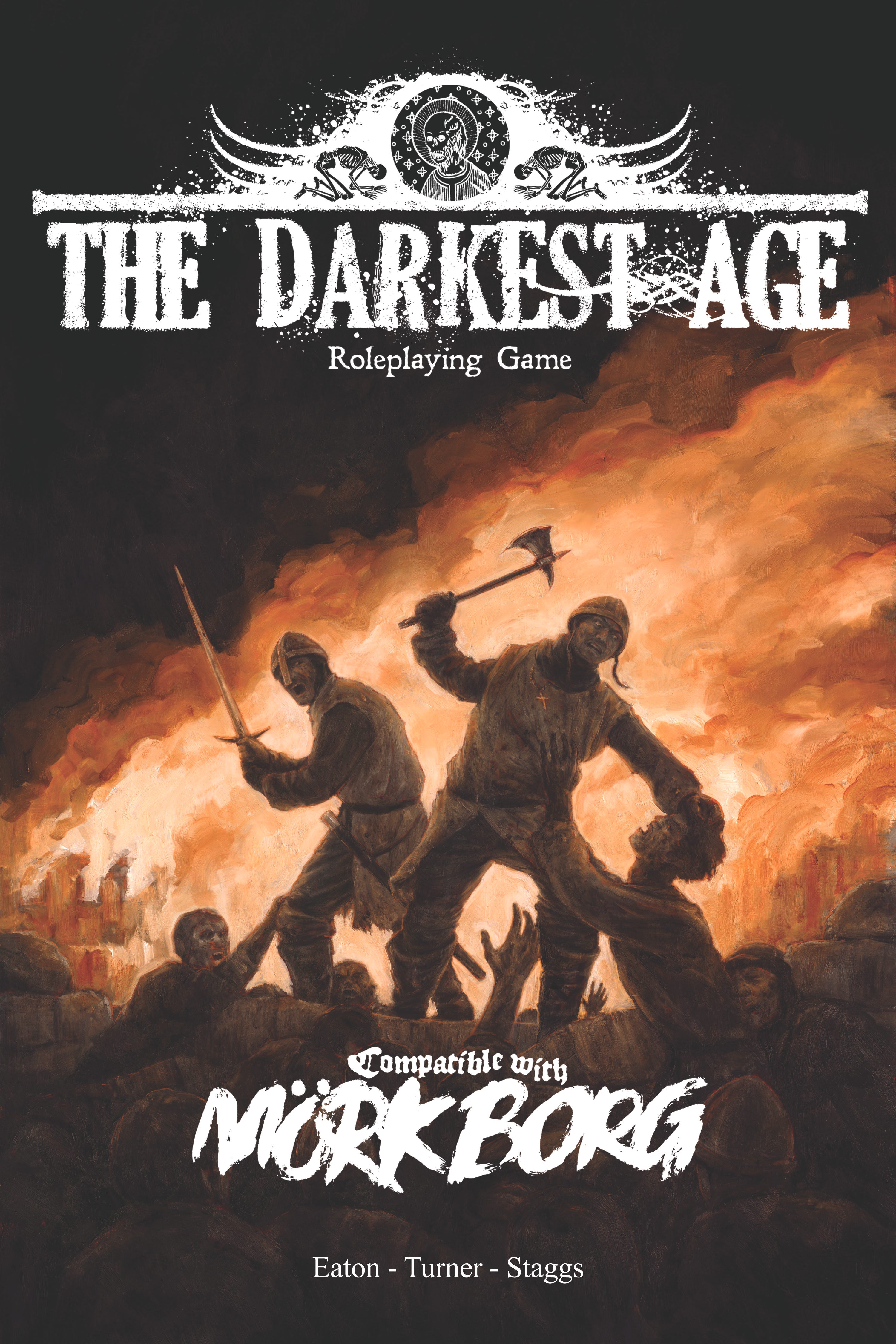
The Darkest Age: MORK BORG Edition
Two others (J. Eaton and D. Turner) have been working tirelessly to make this new edition of The Darkest Age happen. Thanks to their diligence and focus, we are able to present TTRPG players, Horror/Survival RPG fans, and others with our new interpretation of this medieval zombie apocalypse!
What’s next? The book is going off to the printer for proofs tonight, then, assuming all is gold, we will just publish. That will be a glorious day soon. If you are in the Wisconsin area, stay tuned for release party details.
Photon Road 9
Days became weeks, and the easy friendship that Jane and Peter had struck up continued to grow. Their days were filled with colonial operational training, which consisted of how to drive heavy equipment and set up fabricators, the basic tasks first-wave colonists would have to perform regularly with a minimum of error. Peter found the topic boring, but supposed it was better than pushing data about.
Keep reading with a 7-day free trial
Subscribe to story-moment-story to keep reading this post and get 7 days of free access to the full post archives.