

Map Stuff / ? / Petra21-C
No middle topic?!

Map Stuff
(All the maps shown are my own design for various projects, personal and commercial.)
Oh goodness. Maps for your stories (tabletop role-playing games or fiction) are important for at least the creator, right? You need to keep it all straight somehow. The internal consistency thing again. If it takes six days to get from the Frozen Waterfall to Duke Farp’s Watchtower, it should always take that long, at least if travelling by the same methods.
The question becomes how to make the map. We all know it’s necessary. It’s whether we let it become a time sink or not. There are plenty of apps and sites out there that claim to help with the creation of maps. The first one that comes to mind is Inkarnate.com. I had a paid subscription a few years ago, and I really enjoyed it, but I felt I was paying for time when I wasn’t making maps. Inkarnate’s system is cool, easy to learn, and the results are nice. Of course, they often have similarities, and professional (or even journeyman) cartographers can easily see what elements have been recycled.
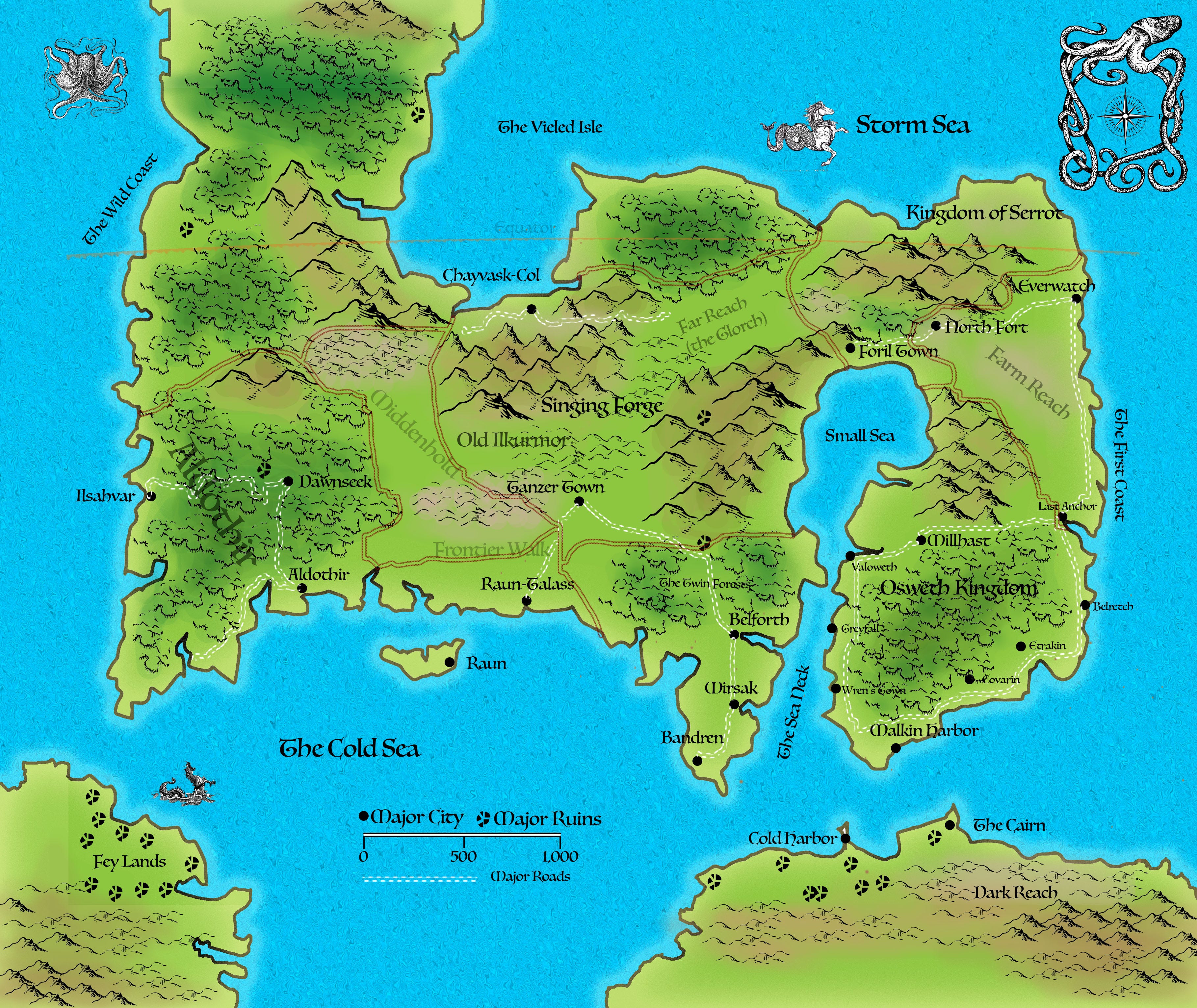
There’s always Campaign Cartographer. A CAD-based and PC only software package that I found difficult to learn and gave up on. I’m sure it’s better now. I’m a Mac user, however, and just about everything else works with Macs, so, you know…
I’ve played in games where the maps were scratched with pens on notebook paper (guilty) and other campaigns where the DM took all the care of an excited 5th grader using their new set of colored pencils, measuring out every single millimeter of terrain. Mixed media, crayon,
Then there’s the middle ground, offered by Virtual Table Tops such as D&D Beyond and Roll20. These are great if the group is committed to virtual gaming. It also requires a bit of a learning curve, and the preptime (to me) feels equivalent. Just using different tools.
I consider myself a bit of an artist and like to hand-draw my maps. I start with nice, heavy drawing paper, then a hard-leaded pencil for light lines. When I like the dimensions of the island, border, continent, or boundary, I use a .07 black gel pen to finalize the external shape. From there, any number of hundreds of techniques can be used. V-shaped mountains, clip-art, pre-made icons, anything really.
Rather unintentionally, I end up making topographical maps first, because the terrain defines the communities or wilderness around it. For example, it’s unlikely to have a community of Selkies living on top of a mountain. But, if you follow the tributaries from the mountains to the streams and rivers, and finally to Jerlak’s Harbor, a naturally sheltered and deep bay, there, you will find the thriving communities of marine dwellers.
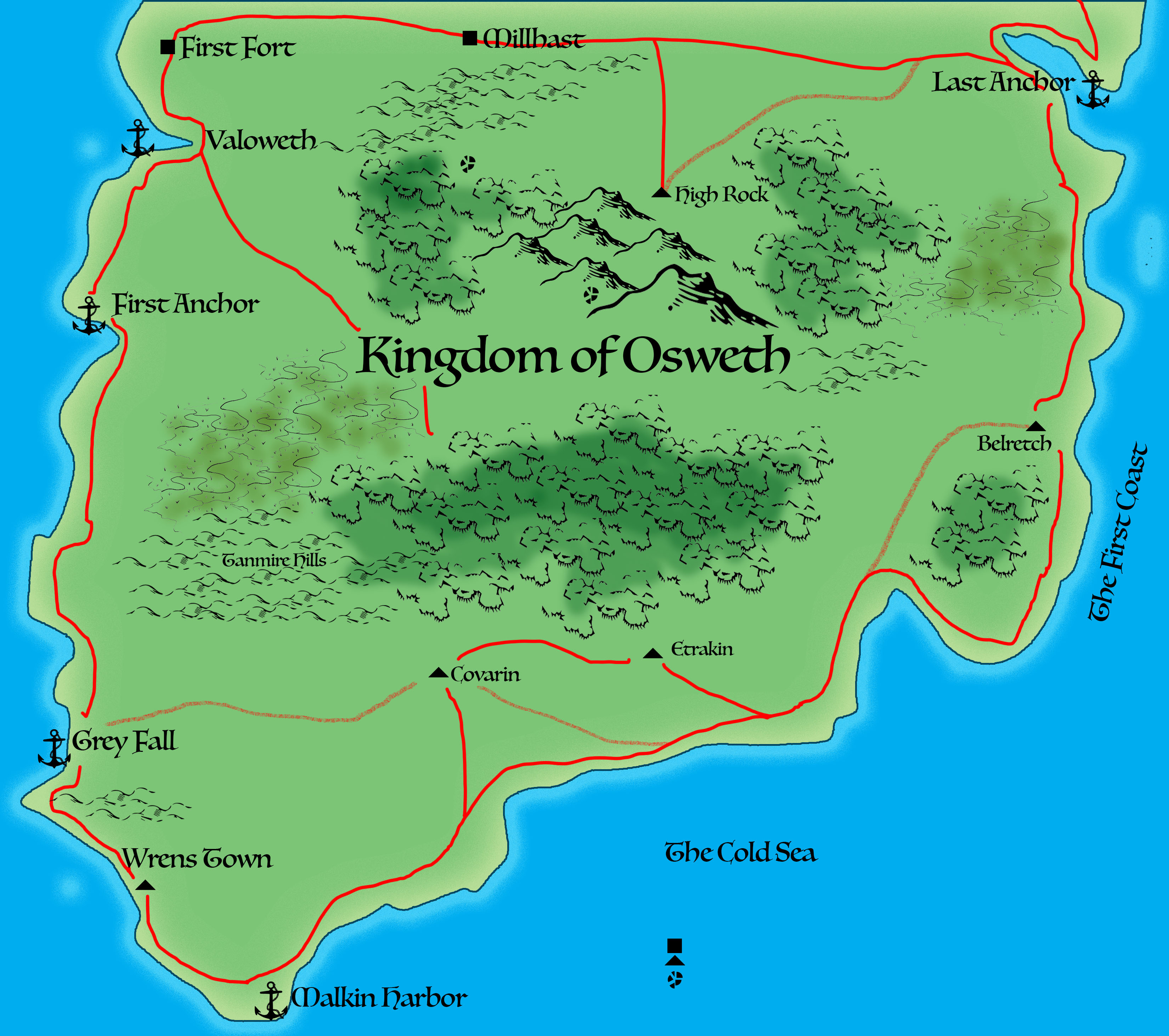
Of course, since it is such a great harbor, a city of surface dwellers has sprung up there. Where there are people, there’s pollution. This would naturally cause conflict between the pre-existing marine nations and the relatively new city. See how that works? Practically writes itself.
For maps, I know I’m going to need to distribute electronically or use them forever and ever, but I do take the time to construct them digitally. For the images I’m going to show, I used Adobe Illustrator to copy the borders, land masses, bodies of water, and whatnot from my original drawings.
Then I import the maps (as .eps, .svg files) into Adobe Photoshop. From there, it’s all about the layers. Dots and names denote cities on the map; starred dots and names for capitals; crossed swords for a battlefield —you get the idea. This is two separate layers, allowing me to move the cities and the words independently. Worried about too many layers? Don’t be. Just put them in layer groups (folders), label them, and rock on. Land features get a layer, rivers and bodies of water get a layer. Roads, trails, and paths get a separate layer. Pretty straightforward.
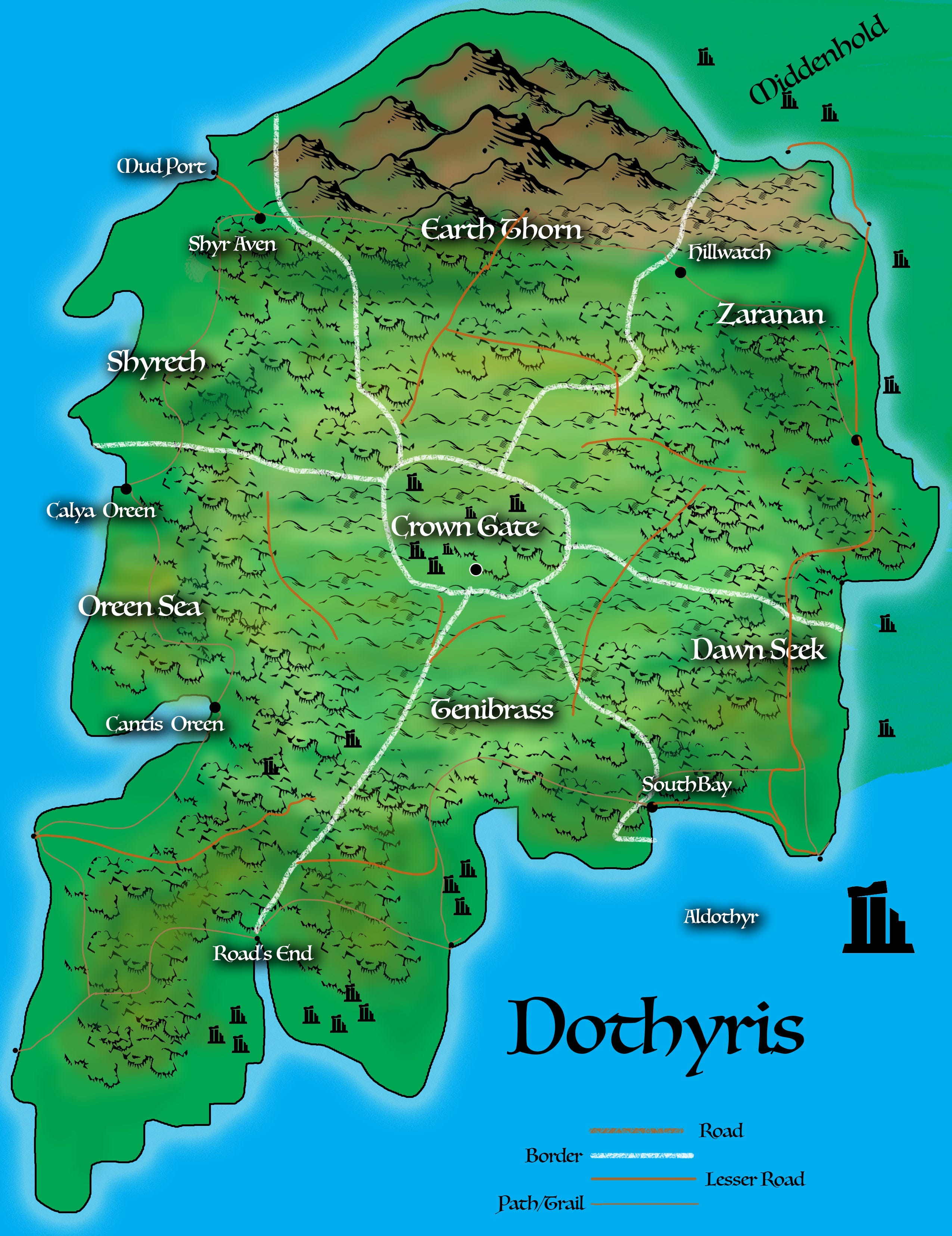
However, choosing the appropriate icons for your map might be a challenge. I purchased a “kit” from a Facebook ad (I know) about a year ago. It was $75 and came with 200 icons, brushes, and backgrounds. I purchased the commercial license, which is why I think it was a little more expensive. Honestly, it was worth about $20. The digital brushes work better in Procreate than in Adobe products. Of course, I do everything in Creative Suite. The icons themselves were sort of useless. How many windmills can you put on a map? The variety of icons/brush tips is limited to single buildings. Nothing for a city or castle. The “urban” icons were useless. But I did use the parchment backgrounds several times.
I’ve found creating your own icons is the most efficient way. Once you have a set you are happy with, re-using them will create consistency that your players will enjoy. A GREAT icon can be stacked next to itself and look natural. Certain types of mountains, for example. Homes or buildings in a city sometimes also work. Trees and forests can benefit from this as well.
In a pinch, a cluster of rectangles and squares can be grouped in Illustrator, duplicated, placed, and then rotated a little (45° to 180°) to make them seem a bit different.
The Map is not the Terrain
A relative authority in medieval maps told me that they were made by feel more than by measurement. This means something could be a few kilometers away, but over rocky hills, it took twice as long to get there. That means it would be placed farther away on the map. Because it takes longer to get there, see? Purely logical, but ultimately false. True or not, I’ve always kept that little nugget in play during gaming.


This is important to remember because The Dark Forest might not actually be dark or even a forest. It could be a vast field of stele that radiates strange magical energy, making it a wild magic zone. Or something worse. The King’s Road might be the most bandit-plagued passage in the realm because it’s the King’s Road. The Fields of Dead could be a battle site, a grave site, or even a holy area protected by cultists or paladins (depending on which side of the line you stand).
The point here is that in-game, the fellow who made the map might have been wrong, devious, or just a fool. A purchased map has no guarantee of accuracy.
Non-Fantasy Maps
If you’re the type of gamer who goes for accuracy, theme, and style, contemporary and sci-fi maps can be a real hazard. I notice that Free League’s Alien RPG Box Sets come with glorious, durable maps. For Cyberpunk, I have an old Night City map from the original supplement. The Marvel Multiverse RPG books have good maps as well.
For custom. Non-fantasy maps, there’s always Inkarnate, I guess. I’ve used the El maps of Chicago and just redrawn or printed and pasted over sections to make it fit my game.
I would like to know what others are using. Creating commercial gaming maps with some of the available resources requires a more costly (commercial) license. So what techniques, refined through trial and error, are others using to create and maintain cartographic excellence?
The Miners of Petra 21-C
In Alcove 18, Simon found a locker and a vacuum suit. He quickly put it on, double-checking the seals, pressure, and life-support supply. By the time he was finished, he could see SUMs drifting, shuffling down the radial tunnel. A few turned into Alcove 18 and began to scan around. The things wandered seemingly without destination. Simon knew better - they were using their short-range sonar and thermal imaging to find him. Which they did, detecting him only moments later. To his advantage, the SUMs were slow, ungainly things with the additional disadvantage of relying on remote systems for instructions.
The thought hit him like a rock to the skull - remote systems for instructions. This meant that they were receiving instruction from somewhere. He was no biomechanist expert, but it was clear that additional directives were being delivered. Simon closed the control room airlock and began cycling the doors.
**
Dr. Pierat could see Simon on his screens, through the eyes of his modified SUMs. He was in the elevated control room of Alcove 18, struggling into a vacuum suit. With a few deft commands, Pierat sent the three SUMs up the stairs, their empty eyes recording every shaky step. Watching intently, Pierat almost missed an opportunity to end his problem. As the SUM in the lead arrived at the upper landing, just outside the control room door, Pierat could see Simon frantically cycling the airlock beyond the control room. Pierat entered s few more commands and stopped the air-lock cycle. Pierat unlocked the inner airlock door remotely and waited. It was only a matter of time before more SUMs arrived, and eventually, they would tear open the control room door, and he would be done with Simon Kyrix.
Rae sat at her station in the dorsal control room, about half a kilometer below Dr. Pierat’s lab, and listened to the com for updates from the doctor, Creed, or Simon. Scanning over displays, she saw that most of the rest of the station was running smoothly. Radials one through seven seemed to be fine, with workers reporting nothing out of the ordinary, and all the SUM signature in the proper place, giving proper returns.
“Creed? Anything?” she asked, knowing the answer already.
“What? No. Ain’t nothing I can do from here. Gotta bring in the broken ones - and I’ll need the doc. I can do hardware diagnostics, but he’s the one you want to ask about the rest of the damn things.”
With a sigh, she asked, “Dr. Pierat, are you on the channel?”
He cleared his throat, “I am.”
Rae rolled her eyes. Would she have to explain everything to everyone, every time? “Well?”
“Ah, yes. Well, Joanne has started software checks. It will take a while to get through all of them.”
With a burst of static, Simon cut in, “Well, I don’t have a while! These things are dangerous, and they’re everywhere. Can’t you shut them off?”
From somewhere else, the disembodied voice of Ms. Fraude interrupted, “Do not do that, Doctor. We’ve only evidence of a few malfunctions, correct?”
“Yes. I mean, about eight percent of active SUMs.” Pierat answered, tapping his console for more information.
“The number was six percent when we sent Simon down there,” Rae argued.
“Still,” Fraude said, “it’s not worth the loss of revenue to shut the SUMs down. That’s over 55% of the workforce. Think of what that would do to productivity.”
“Hey, there are laws against that shit,” said Simon, his voice slightly strained.
“I’m going to ignore that remark, Mr. Kyrix,” said Fraude, her tone icier than her usual aloof coolness.
Pierat turned down the comm volume and called up a schematic of Radial 8. Unconsciously, he touched his face, rubbed his chin while he thought about the problem and the dozens of potential outcomes. There was a tone of panic rising in the voices on the comm. Creed was asking questions he already knew the answer to - wasting time, stalling. Pierat thought he was probably afraid to confront their creations.
In the airlock of Alcove 18, Simon firmly decided he wasn’t going to die by being disassembled by walking, battery-powered corpses. He unsealed his vacuum suit and pulled a simple screw drive from his vest, then frantically resealed himself. The gloves of the vacuum suit were thick but allowed him enough dexterity to manipulate most tools. Jamming the screwdriver into the airlock control plate, he pried the casing open.
Far away, through the eyes of the SUMs, Pierat watched as Simon Kyrix outsmarted him.
Simon could hear the steady thumping against the control room door, then the sounds of wrenching steel, some sort of machine powering up. He spared a glance to his right, out the airlock inner door, and saw the SUMs enter the control room. The lead SUM had ruptured its polymer casing while passing through the twisted metal. It was oozing a filthy combination of rotting flesh, sour proteins, and hungry nanites. The SUM almost deflated as it stepped forward. It was smashed aside by two others, who rushed the inner airlock door. Simon turned back to his work and tried to ignore the louder, more insistent thumping and banging.
Focusing as best he could on the task at hand, the single task that might save his life, Simon opened a panel connected to the outer airlock door control. In moments, he had the cover off. He tugged wires loose, stripped them to make connections where there should be none.